
Timeframe: 2019–ongoing
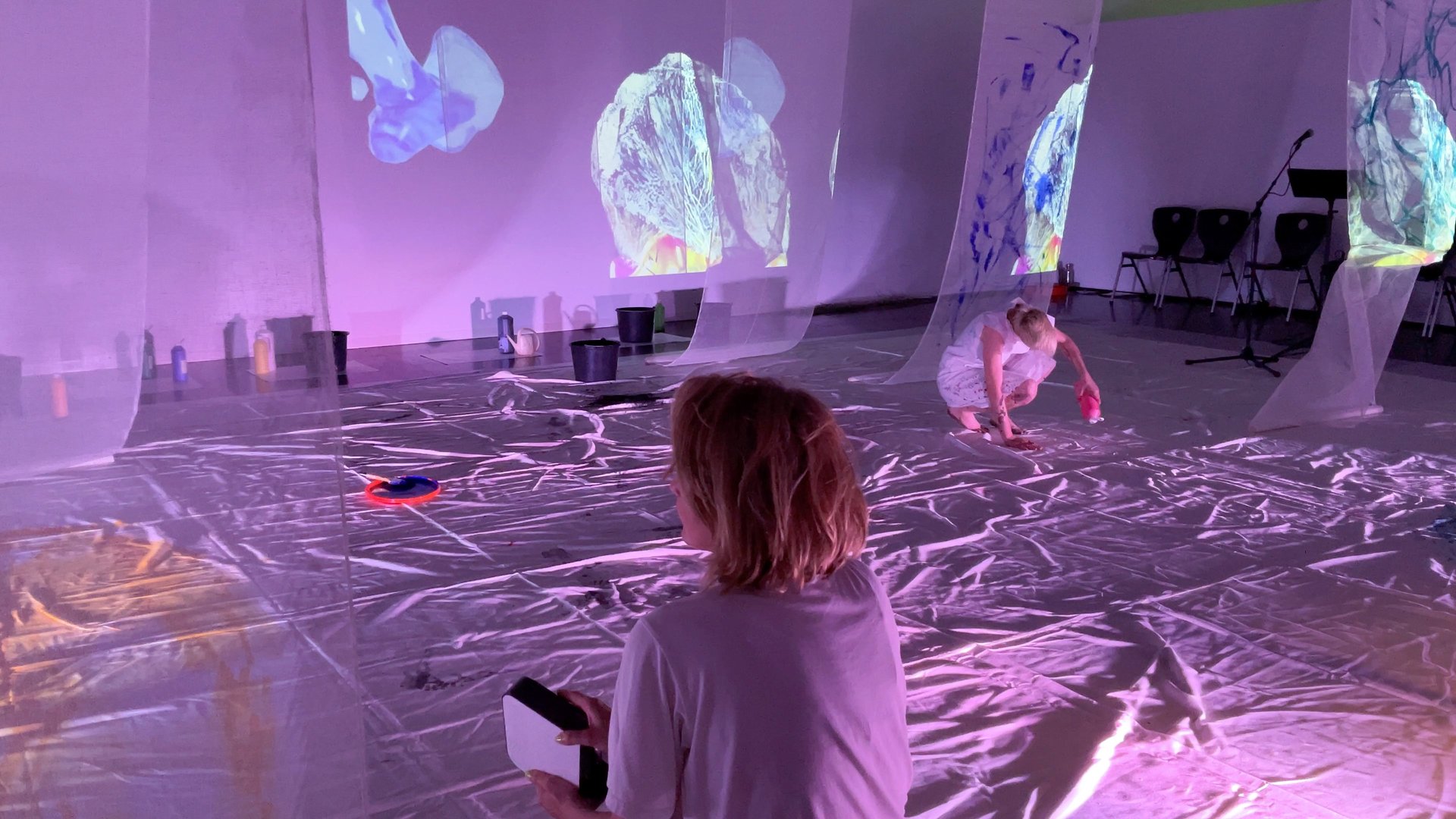
[freq:res] is a long-term artistic research project investigating the relationship between sound and visual form through frequency-based structures and real-time audiovisual systems. The work examines how acoustic parameters — frequency, rhythm, amplitude, and vibration — operate as compositional forces capable of generating visual behavior over time.
The practice centers on sound as a structural input rather than an accompanying element. Acoustic signals directly shape spatial, temporal, and perceptual conditions within abstract visual systems, producing forms that are responsive, dynamic, and non-deterministic.
Grounded in data-informed processes, live improvisation, and modular system architectures, [freq:res] unfolds across performance, installation, and collaborative experimentation. Listening functions as a methodological tool, guiding real-time decision-making within constrained visual frameworks.
Within this research, frequency is treated as architecture, vibration as composition, and improvisation as a mode of inquiry — enabling adaptive, site-responsive work in which visual form emerges through feedback, constraint, and temporal modulation.
Timeframe: 2025–ongoing
[opt:exp] is a long-term artistic research line investigating optical systems, light-based phenomena, and perceptual processes as structural and compositional tools within audiovisual practice. The research explores how light, signal, and optical behavior can function as active agents that shape spatial, temporal, and embodied experience, approaching light as a performative and relational medium rather than a purely visual element.
Positioned at the intersection of contemporary art, scientific inquiry, and experimental media, [opt:exp] focuses on the performative potentials of responsive light systems, including wearable LEDs, projection environments, and dynamically modulated optical behaviors. Light is treated as a structural and relational material, influencing perception, orientation, and bodily awareness in real time.
The study unfolds across performance, installation, and collaborative experimentation, often in dialogue with scientists, technologists, and theorists. Through site-specific testing and live systems, [opt:exp] frames optics as both a material and methodological field, enabling research into perceptual thresholds, signal-driven systems, and dynamic audiovisual emergence.
Live improvisation is a central methodological component of the practice. It functions as a research tool through which audiovisual systems are tested, calibrated, and generated in real time. By treating sound, image, and light as interdependent variables, improvisation creates immediate feedback between sensory input, system behavior, and performative decision-making.
Beyond expressive gesture, live improvisation is employed to investigate temporal structures, perceptual thresholds, and site-specific conditions. It allows complex audiovisual systems to remain open, adaptive, and responsive, supporting research processes that prioritize emergence, real-time modulation, and situational awareness over fixed compositional outcomes.
Interdisciplinary collaboration is central to the development of the practice. Projects emerge through ongoing exchange with artists, musicians, scientists, technologists, and theorists, forming hybrid research contexts that connect artistic inquiry with scientific and technical investigation.
These collaborations enable the exploration of complex systems, including acoustics, optics, data processing, and perceptual phenomena, supporting the creation of works that operate across disciplinary and methodological boundaries. Collaboration is approached not as a service relationship, but as a shared experimental process, in which knowledge, tools, and methodologies are collectively tested, adapted, and reconfigured to generate emergent audiovisual behavior.